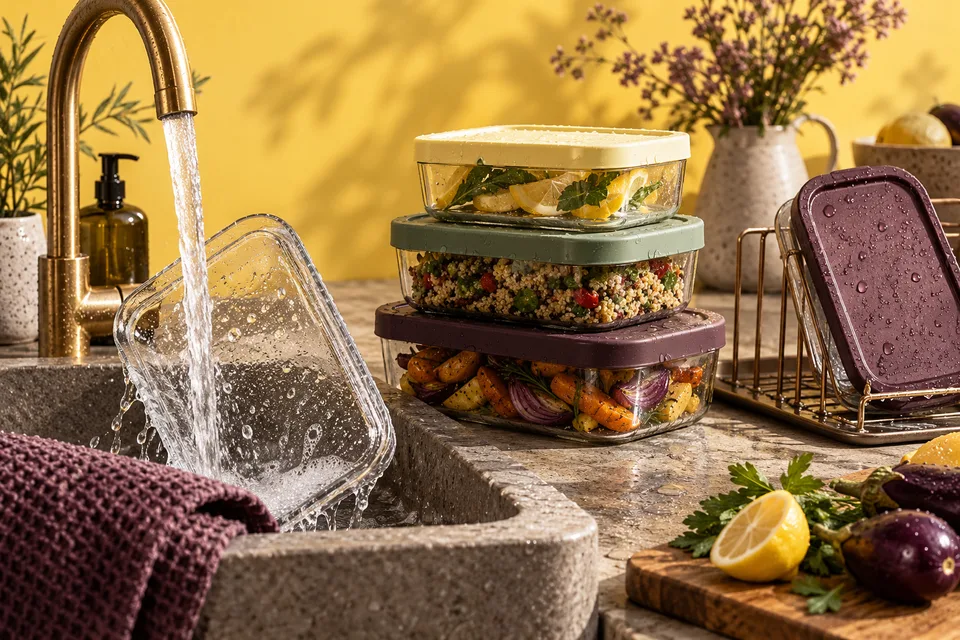
The first trip is easy to admire. A takeaway meal leaves the counter in a sturdy container instead of a disposable one. The customer sees a visible change, and the restaurant can count a reusable package issued. But the environmental proposition depends on what happens after dinner.
The box has to return. Someone has to collect, clean and inspect it, and it has to reach another customer. A container kept in a cupboard may remain perfectly capable of reuse while doing no work for the shared system. A container discarded after one meal has offered durability without earning the benefit of repeated service.
UNEP’s 2020 review of takeaway packaging life-cycle assessments emphasizes the whole reuse arrangement, including return transport and washing. Its findings depend on sufficient reuse and the surrounding system. It does not establish a universal number of trips at which every material, in every city, becomes environmentally preferable.
The distinction should shape both the design and the claim. Reusable describes a capability. Reused describes something that happened. A credible service needs to connect them, repeatedly, rather than allow the first attractive container to stand for the history it has not yet acquired.
Trip one: the heavier beginning
A container intended for repeated use may require a different amount of material and manufacturing effort from a lightweight disposable alternative. That initial investment can be distributed over many meals, provided those meals actually occur. The accounting therefore needs a useful lifetime, not just a theoretical one.
Consider an invented impact index. Manufacturing a reusable box costs 100 units, and each completed wash-and-return cycle adds one unit. A single-use alternative costs ten units for each equivalent service. Ignore all other effects for this illustration. With the first use followed by nine completed cycles before the tenth meal, the ten-use average is (100 + 9) ÷ 10 = 10.9 units. At twenty uses and nineteen intervening cycles, it is (100 + 19) ÷ 20 = 5.95. The arithmetic changes because the initial 100 is spread across more services.
These numbers are not an assessment of any material or product. They demonstrate why a break-even result needs its assumptions. If the recurring impact rises, the comparison changes. If the initial manufacturing impact differs, it changes again. If the container performs a different service, the comparison may not be valid in the first place.
Different environmental indicators can also have different break-even points. A favorable climate result does not automatically establish the same result for water or another resource. A clear claim names what was compared and which outcome was assessed, rather than presenting one favorable indicator as a complete environmental verdict.
The most useful calculation is consequently one that an operator can relate to the real system. It should show the service, the life assumed, the recurring work and the alternative. An impressive number of possible uses printed on a product sheet is only one input to that task.
Trip two: the customer must know where the box goes
The return instruction is part of the product experience. If it is confusing, inconvenient or easy to forget, the box may leave the network despite remaining undamaged. A service asking for a repeated behavior needs to fit people’s ordinary movements.
Return locations matter. A customer who can leave the container where they normally shop faces a different task from someone who must make a special journey to the original outlet. Opening hours, signage and the time allowed for return can all affect participation. These details are less glamorous than a new material but can determine whether that material gets used again.
A deposit or another incentive can encourage return, yet it needs an understandable procedure. Customers should know what is charged, how it is recovered and what happens if a container is damaged or overdue. An ambiguous charge can create frustration instead of a durable habit.
WRAP’s 2022 research on reuse and refill participation followed shoppers in retail refill settings and examined interventions. Clear prices, understandable instructions and staff support were among its recommendations. Those findings concern particular refill trials, not measured return rates for every takeaway service. They nevertheless show why participation depends on the surrounding experience, not simply willingness to protect the environment.
There is also an accessibility question. A system that requires a particular phone, account or payment arrangement may be convenient for some customers and exclude others. The operator should investigate whether the return mechanism is available to the people using the food service. A public message about universal participation needs a practical route that supports it.
A small loss compounds
Return percentages can sound high while implying a much shorter working life than the container’s physical design allows. The reason is repeated exposure to loss: each trip presents another chance for a box to leave circulation.
In a simplified mathematical model, suppose every issued container independently has the same probability of coming back for another use, and there is no wear limit. If that probability is 90%, the expected number of uses, including the first, is ten. At 95%, it is twenty; at 98%, it is fifty. These are results of a geometric series, not observed performance of a reuse scheme.
| Return chance on every trip | Expected uses in this model |
|---|---|
| 90% | 10 |
| 95% | 20 |
| 98% | 50 |
The model uses expected uses = 1 ÷ (1 − return probability). It assumes an unchanged independent probability after each use and no physical retirement. These are illustrative mathematical results, not measured return performance or environmental break-even points.
Real services have damage, inspections, delays and changing customer behavior, so the model is deliberately incomplete. Its point is the sensitivity. A small improvement in retention can make a large difference to the useful life of a shared stock. A physically durable container does not reach fifty trips merely because it survives the washing machine fifty times.
The return-rate denominator also needs care. Boxes issued this week may still be with customers next week. Counting all of them as lost immediately can understate eventual return; waiting indefinitely can hide a stock problem. An operator needs appropriate cohorts and time windows to understand what is happening.
Average completed uses is another useful observation, provided the calculation explains which containers it includes. A few long-lived examples should not stand for a whole fleet containing many early losses. A container celebrating its hundredth meal is a good story, but the environmental and financial system needs the less successful boxes in its account too.
Between trips: clean is an operating standard
The return point is not the point of reissue. Used containers need handling, suitable cleaning and inspection within a food-service arrangement. A successful collection system can still fail if the operator cannot process the returned stock reliably.
The European Commission’s overview of packaging requirements describes reusable packaging as needing to withstand repeated use and meet applicable hygiene and safety requirements. The practical lesson is to design for emptying, cleaning and refilling; this is not a home-cleaning recipe or a certificate for a particular container.
An operator needs clarity about responsibilities. Who receives the used package, who washes it, who checks its condition and who decides when it leaves service? The procedure should remain workable during a busy shift, when a return pile can otherwise become an extra task no one clearly owns.
Washing also belongs in the resource account. Energy, water and cleaning materials do not disappear because the box avoids a new manufacturing cycle. A process using equipment efficiently presents a different calculation from an improvised arrangement running repeatedly with little stock. The environmental assessment needs the process that will actually operate.
Container design can help or hinder that work. Compatibility across the fleet can make storage and processing easier. A proliferation of shapes and lids can create sorting and matching tasks. The smallest possible package is not necessarily the easiest item to maintain through many complete cycles.
The food must remain in view too. Packaging serves a purpose: carrying an appropriate meal in a usable condition. A service should not celebrate reduced packaging while ignoring avoidable food loss or failures in containment. The comparison needs equivalent food service, not merely objects that look similar on an empty shelf.
Across town: the loop needs a route
Collection and redistribution can use existing movements or create new ones. A return network distributed through a city needs an account of where containers accumulate, where they are washed and how clean stock reaches outlets. The map can be as consequential as the material.
A concentrated setting, such as a campus, offers different logistics from many scattered independent restaurants. Customers, collection points and washing may be closer together. An assessment or pilot from one setting should not silently become evidence for another with a much longer route.
Fleet size has to accommodate time away from the counter. Stock sits with customers, waits for collection, passes through cleaning and returns to use. If the operator buys only enough boxes for the meals served at one moment, it may run short even with a strong eventual return rate. A functioning loop needs working inventory as well as durable objects.
This is an economic issue too. Someone pays for replacements, transport, cleaning, storage and administration. A restaurant can avoid purchasing disposables and still incur another service cost. The buyer needs a comparison of complete arrangements, including the workload transferred to staff or customers.
WRAP’s current work on scaling reusable and refillable packaging emphasizes collaboration, interoperability and system-wide barriers. It includes the Reuse Packaging Partnership established in 2025. The agenda points toward shared infrastructure rather than a separate incompatible loop for every brand, although membership in an initiative does not establish an individual service’s environmental outcome.
Shared systems bring governance questions. Participants need agreed quality, data and financial arrangements. A container collected by one business and owned by another cannot rely on goodwill alone at scale. The opportunity for convenience comes with a need to organize the common service.
The rules are moving; the trips still have to happen
European packaging policy has increased attention to reuse, but its dates and obligations are phased. The Commission’s August 2026 announcement states that the Packaging and Packaging Waste Regulation began applying on August 12, while several other measures take effect later. That milestone does not mean every future reuse target or labeling requirement started on the same day.
Policy can help create conditions for investment, standardization and participation. It does not itself return a container. An operator still needs a service people use, a processing arrangement that works and evidence connecting its environmental claims to its actual performance.
For a new scheme, a well-designed pilot should therefore measure the loop: containers issued and returned, time in circulation, usable completed cycles, washing and transport, damage and replacement. It should examine why customers fail to return and whether an adjustment improves the result. Counting the first distribution event is not enough.
Those findings should then shape the claim. If the assessment depends on twenty uses, the operator needs to understand whether the fleet is approaching that life under actual conditions. If a change improves returns but substantially alters logistics, the account should incorporate both effects. A reuse system is a service that can learn, not a permanent virtue attached to a box.
The first trip remains worth making when it begins a credible loop. The more meaningful photograph comes later: a clean container ready for another meal, backed by a system that knows how many times that scene has occurred. The package has stopped promising another life and started living it.
Sources & context
This article draws on the sources linked in the text. Analysis and illustrative scenarios are identified separately from reported findings.
- 2020 review of takeaway packaging life-cycle assessments
- 2022 research on reuse and refill participation
- overview of packaging requirements
- current work on scaling reusable and refillable packaging
- August 2026 announcement