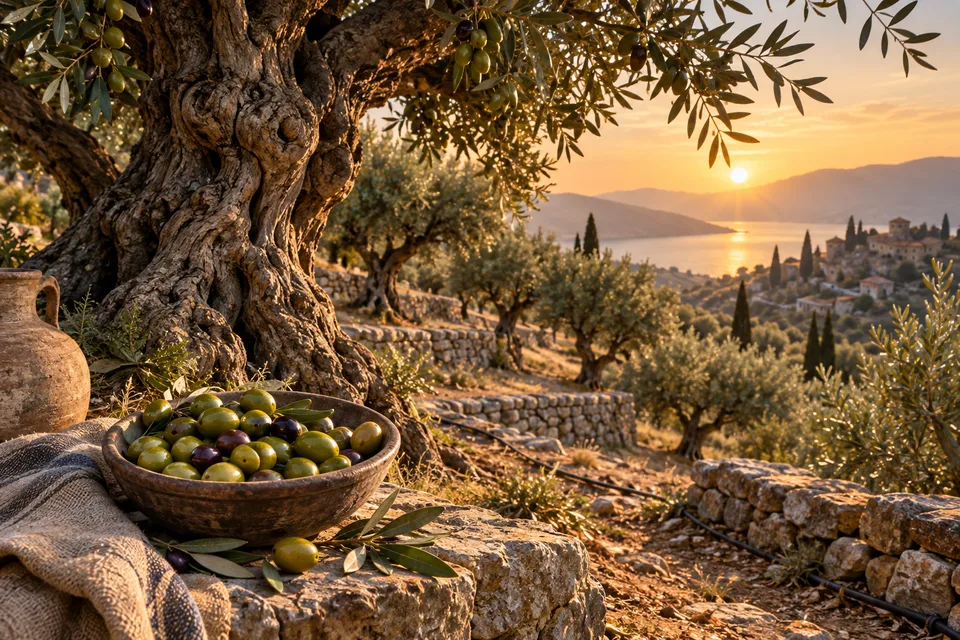
An olive tree can endure a difficult season while producing too little fruit to sustain the business around it. That gap between survival and harvest is where the familiar story of Mediterranean resilience becomes an agricultural question. Flowering, water and the cycle between heavier and lighter crops all shape what the grove can deliver. The old trunk is striking evidence of persistence. A viable future also needs a crop, an affordable way to tend it and people able to keep doing the work.
The University of California’s 2018 drought guidance for table and oil olives makes the distinction plainly: drought tolerance does not remove the role of irrigation in commercial yield and quality in the California systems discussed. The relevant question is not only whether an olive can endure, but what kind of harvest it can provide under particular conditions.
That distinction extends beyond water. The crop has a biological calendar; the orchard has a financial one. Flowering happens in a season, while choices about varieties, planting design and infrastructure last much longer. A hot spell or an unfavorable winter can affect one harvest, but the response may commit a grower to a system intended to operate for years.
The climate story is therefore not a simple confrontation between an ancient tree and a new temperature record. It is a changing relationship between a living crop, a place and an operating business. The familiar image of toughness needs to make room for all three.
Before the oil, the flowers
An olive-oil story often starts at harvest, with fruit entering a mill. By then, important decisions about the crop have already been made by the tree and its environment. A poor flowering season cannot be repaired by a more attractive bottle.
Research on flower induction makes the winter part of the account especially important. A 2023 study of several cultivars investigated fruit load, winter drought and temperature regimes. Its winter-drought experiment used five cultivars in large pots in Israel. Water stress during that experiment did not significantly alter subsequent flower induction, while previous fruit load and the sequence of winter temperatures remained important to the wider study. That is a narrow finding about flowering under the tested conditions, not evidence that water stress cannot damage an olive crop. The authors also found that chilling models did not adequately capture the reduction associated with warm winters. Treating every winter stress as the same mechanism would lose precisely what the experiment helps distinguish.
This is a more subtle problem than calculating an annual average temperature. The sequence of conditions can matter: when cold occurs, when warmth interrupts it, and what follows as the plant develops. Two years with similar averages can present a tree with different seasonal experiences. A simple warming map can indicate concern without explaining the full crop response.
The location and cultivar matter too. A 2023 study of olive flowering in Portugal’s Alentejo region found interacting winter and spring effects rather than a simple uniform shift in onset. It highlighted increasing year-to-year variability in flowering timing. That local result should not be turned into a claim that every grove flowers earlier by the same amount.
For a grower, variability can be difficult even when the average looks manageable. Harvest labor, mill capacity and expected sales are organized around a seasonal business. A system that sometimes works well and sometimes misses a critical biological window presents a different risk from one that declines smoothly at a predictable rate.
Previous crop load further complicates an annual comparison. Olives can show alternate bearing, with the crop in one year affecting the next. California researchers’ account of alternate-bearing mechanisms, published more than a decade ago, also describes the capacity of unfavorable conditions to interrupt an expected pattern. The mechanism helps explain why one year’s national production change is not a clean experiment isolating the effect of climate.
It does not make climate irrelevant. It means climate analysis needs the crop’s existing rhythms. The right story can describe an interaction without pretending every disappointing harvest has one cause.
The water decision reaches beyond the grove
Irrigation can support production, but access to water is a shared condition, not a property a grower can conjure by purchasing equipment. A new system needs a credible supply as well as a means of applying it. Under scarcity, other farms, households and ecosystems may depend on the same resource.
An efficient application system can reduce some losses in delivering water to the crop. It does not, by itself, establish a sustainable allocation across the catchment. The operating account needs to consider what is available, who can use it and under which conditions. A farm-level efficiency claim and a regional water-security claim answer different questions.
That distinction changes the investment proposal. “Install irrigation” is a solution only when the supply, permissions, cost and management make sense. Otherwise the project can replace one exposure, rainfall variability, with another exposure, dependence on an uncertain or expensive source.
The orchard’s intended product matters as well. Table olives and olives for oil have different commercial requirements. Fruit size can be especially important to a table-olive market; oil production brings its own yield and quality objectives. A response chosen for one product should not be assumed to solve the other’s constraints.
This is where local advice and evidence become more useful than a global ranking of hardy crops. A grower needs to understand the variety, soil, production objective and water arrangement in front of them. A broad image of drought tolerance is too coarse to decide how that business should operate.
There are also choices about land management beyond irrigation. Soil cover, access for work and erosion concerns can enter the design. The appropriate arrangement depends on the setting and available resources. A hillside landscape and a highly mechanized planting cannot simply inherit each other’s practices because both contain olive trees.
Replacing an orchard is not replacing an annual seed order
Adaptation can involve varieties, infrastructure, management or location. Each has a timescale. An orchard is a durable commitment, and changing it can bring years of adjustment before the intended production pattern is established.
The International Olive Council’s world catalogue of varieties makes the crop’s diversity visible. That diversity provides material for research and adaptation. It does not establish one cultivar as a universal replacement for all groves facing warmer or drier conditions.
Variety choice interacts with the production system. A tree needs to suit the place, the desired product and the way the orchard will be managed. Processing and marketing enter that decision too. A biological candidate for a changed climate still has to fit a business capable of harvesting and selling its crop.
For a small grower, capital and uncertainty can be decisive. Replanting or adding infrastructure is easier to recommend than to finance. The grower may have to manage existing income needs while investing in future production. A long-term climate benefit is not cash available for the next bill.
Public support can help, but it should not assume every grower has the same land, tenure, market or ability to borrow. An intervention that works for a large operation may be inaccessible to a smaller one. If adaptation policy only rewards those already able to make expensive changes, it can improve selected production systems while leaving other communities more exposed.
There is a cultural dimension without a reason to romanticize hardship. Traditional groves can be important landscapes and livelihoods. Their value deserves recognition, but maintaining them still requires people with workable incomes and services. Preserving the appearance of an agricultural landscape while allowing its farming economy to fail is not preservation in a durable sense.
The choice is not between every old grove staying exactly as it is and all groves becoming identical modern plantations. A credible regional strategy can investigate several routes, including improvements to existing systems, targeted changes and support where the wider landscape has public value. The decisions need evidence about both production and the place.
A recovery in supply is not a cancellation of risk
Olive-oil prices provide a highly visible account of scarcity, but they are an incomplete climate indicator. Supply, stocks, demand, quality and trade enter the market. A lower price can accompany relief in production without establishing that the long-term agronomic problem has disappeared.
The IOC’s January 2026 statistical release estimated a strong global production recovery in 2024/25 and forecast a modest decline for 2025/26. Those figures were provisional and forecast values at the time of publication. They should not be described as a final account of every subsequent harvest or as today’s retail price.
The same release showed different changes among producing countries. A world total can recover because some regions contribute more while another produces less. The aggregate is useful to a market analyst, but it does not tell a farmer that their own grove has become less vulnerable.
The Council’s June/July 2026 update also records different movements in representative producer markets, with observations from specified weeks. These are dated producer-price measures, not interchangeable quotes for bottled oil on supermarket shelves. Retaining the date, location and market level prevents a seasonal report from pretending to be a live price ticker.
The retail response can follow its own timing. Oil already purchased, packaging, distribution and commercial decisions all lie between an upstream market and the next bottle. A change in one does not require an immediate, equal change in the other. This is not a claim that any particular price is justified; it is a reason to investigate the chain rather than assume a direct one-to-one translation.
For the producer, a supply recovery can even bring a different pressure. More oil available in a market can affect the revenue earned per unit while a grower’s costs or previous losses persist. A good physical harvest and a sustainable annual income are related, but not identical outcomes. The farmer’s resilience cannot be read solely from the world tonnage chart.
Endurance has become an operating question
A resilient grove is not simply one that remains green during a difficult summer. It is a crop and a livelihood able to function through a range of conditions, with the resources and knowledge to adjust. That definition brings less photogenic subjects into view: seasonal records, reliable water arrangements, appropriate varieties, processing access and the ability to finance change.
The most useful research separates the mechanisms while examining their interaction. Flower induction, fruit development and water stress are not one undifferentiated weather effect. The most useful market reporting does the same with quantities, prices and time. Clear distinctions make the connections easier to understand.
Growers also need support that lasts beyond a single alarming season. A drought response can address an immediate shortage, while orchard adaptation concerns a longer investment horizon. Waiting for the next crisis to reopen every decision makes that work more difficult. Equally, an expensive permanent change should not be justified by a single year’s data without examining the broader conditions.
Consumers can make a smaller contribution to the discussion by keeping origin and quality information in view without demanding a simple heroic story. An oil comes from a production system, not just an iconic tree. The people managing that system are working through biological uncertainty, infrastructure and markets, often at the same time.
The old tree remains a striking image. The new definition of endurance includes whether the people around it can keep making a living, and whether the place can support that work. Without those conditions, survival alone leaves too much of the olive story untold.
Sources & context
This article draws on the sources linked in the text. Analysis and illustrative scenarios are identified separately from reported findings.
- 2018 drought guidance for table and oil olives
- 2023 study of several cultivars
- 2023 study of olive flowering in Portugal's Alentejo region
- account of alternate-bearing mechanisms
- world catalogue of varieties
- January 2026 statistical release
- June/July 2026 update